Sustainable Agriculture
“The animal protein culture, conventionally viewed as improved consumption in a ‘nutrition transition’, has serious environmental and health consequences. Eating plants directly rather than in meat, dairy, eggs, much less of the crop is required to deliver the same amount of protein, without the pollution and pandemics.” The Lancet
Agriculture that works harmoniously with nature, and avoids animal exploitation, can lessen food insecurity, provide greater income for farmers, and enhance human health. Veganic Agriculture in North America, Stock-Free Organic Agriculture in Europe, and Natural Agriculture in India all use sustainable practices, with no disease-causing animal inputs, or expensive fertilizers and pesticides.
Sustainable veganic agriculture uses no animal inputs – manure, blood, or bone meal from factory farms and slaughterhouses as is used in organic farming for soil fertility. Instead, it uses cover crops, veganic compost, and imaginative and creative uses of green manures – plowed under nitrogen rich cover crops. Some are plowed under, some are killed and left on the surface of the soil for crops to be planted into, and some are planted between rows. Different green manures offer different benefits to the soil. Soil fertility is key to nutritious food since crops take their nutritional value from the soil. Manure used as fertilizer can cause serious health consequences for humans. Salmonella and E. coli can spread to vegetables and contaminate them.
Tasteless fruits and vegetables indicate that they have been grown in depleted soil. Soil that is depleted cannot product crops that have vitamins, minerals, and taste. All elements found on the Periodic Chart of the Elements are needed for the human body, and all except a few are found in soil.
Harmful pesticides are not needed in veganic agriculture because pests are managed through crop rotation, unlike organic farming which, like conventional farming, relies on harmful pesticides. This is more healthful for consumers, and more lucrative for farmers.
Land is divided into quarters. One field is left empty to rest and allow for replenishment. Nitrogen rich cover crops are planted and eventually plowed under to replenish the soil and provide a natural fertilizer. Crop rotation is planting a different crop in each field each season, or simply moving a crop to the next field to avoid the pests.
No pesticides are needed because by the time the pest find the crop, it has been moved. The philosophy, “Know your Enemy”, involves diagnosing the pest or disease. Its life cycle is analyzed to find the vulnerable point. Next the philosophy, “My Enemy’s Enemy is my Friend”, is employed, and a predator is found that can control situation at that vulnerable point. This eliminates the need for toxic pesticides, even the “natural” poisons used in organic farming. Veganic farming also relies on the use of harmless soaps and ashes for pest control.
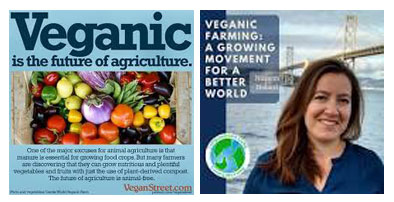
Veganic produce is more healthful without dangerous chemicals, is less expensive to produce, more healthful for consumers, and more lucrative for farmers. Veganic produce is loaded with vitamins and minerals, and has no toxic or poisonous pesticides, no hormones or antibiotics from animal manures and inputs as used in conventional and organic farming, has a light carbon footprint, is globally sustainable, and is totally cruelty free.
Veganic agriculture is more healthful, sustainable, and compassionate than conventional or organic! Try it!